Integer Types
Integer Types, what are integers in math
Integers form the foundation of calculation in maths. Whether we are solving simple arithmetic problems, working with algebraic expressions, performing integer arithmetic in computer architecture, or developing advanced calculators, they play a critical role.

They represent whole values without fractional or decimal parts, making them ideal for clear, precise, and error-free calculations. In this article, we will explore the definition, important types, their usage in modern mathematics, and how they power advanced online calculators
What is an integer in math
The integer can be a whole values, can be +ve, -ve, integer 0. Unlike decimals and fractions, they do not contain fractional parts. This makes them simple yet powerful, widely used in arithmetic, , number theory, and computational systems.
Integer and Whole Number
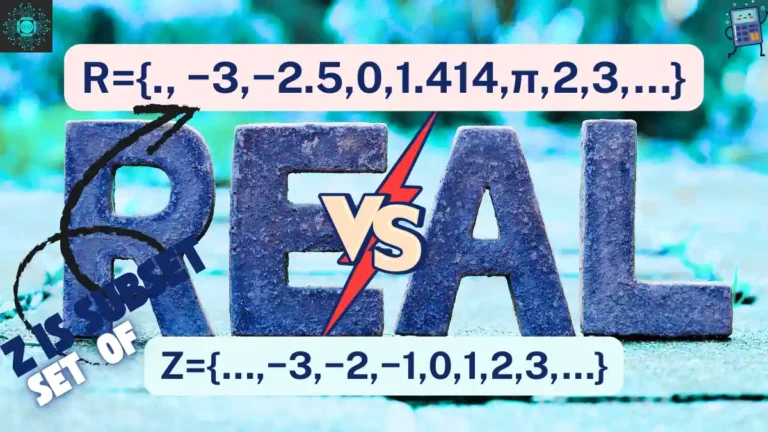
It includes all +ve numbers, -ve numbers, and zero, while a whole number includes only zero and +ve values. This means all whole values are integers, but negative integers are not whole numbers. they extend in both directions on the number line, making them more useful for showing loss, direction, and temperature changes. We hear temperature drops to -10C and such examples in our routine life
Integer Value Examples:
-5, -4, -3, -2, -1,0, 1, 2, 3, 4, 5, 6
These are represented on a number line extending infinitely in both directions. Zero stands at the center, positive lie to the right, and negative lie to the left. Their ability to describe increases and decreases, gains and losses, and directional changes makes them highly practical in real-life situations and computer-based applications.
Integer Types
Although the types appear simple, they can be divided into several important categories. Understanding these integer types helps learners and calculator users perform more precise operations.
1. Positive:
These are whole numbers greater than zero. They represent quantities, counts, and natural numbers used in daily life. An integer data type example for whole numerical values includes 0, 1, 2, 3, 4 and so on; it stores whole values without decimals, making it suitable for counting, indexing, and simple arithmetic operations.
2. Negative, 5 Examples
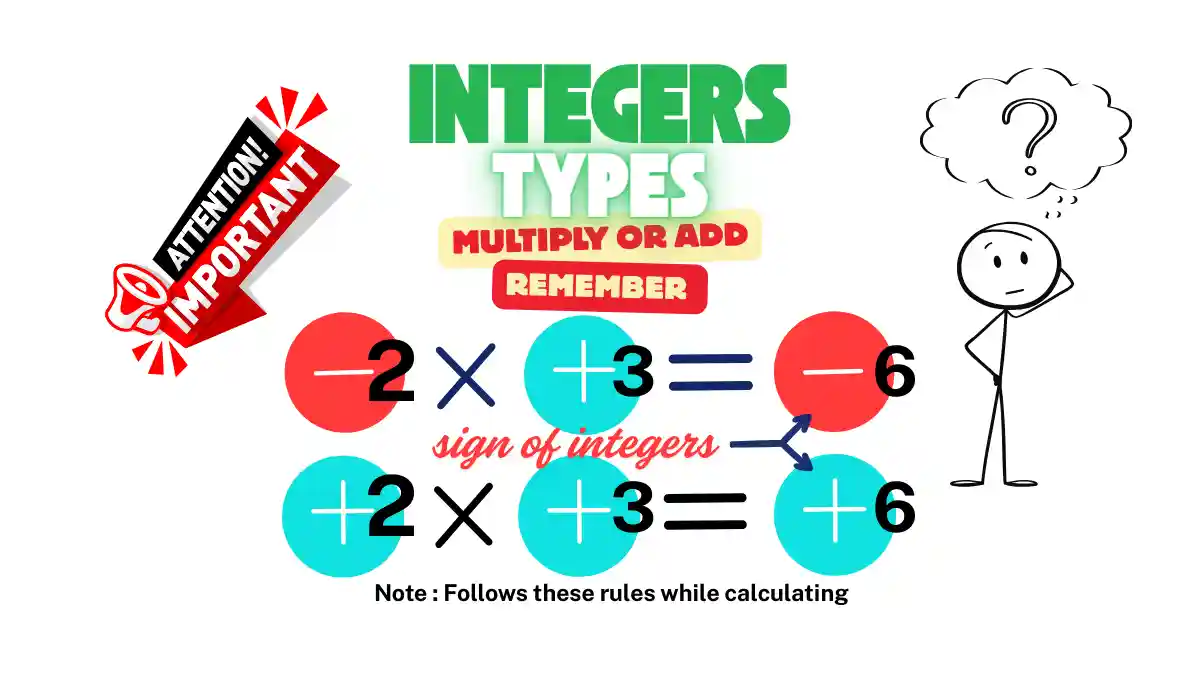
Numerical values less than zero are classified as negative integers. They are used to show decreases, deficits, or positions below a baseline.eg−1, −3, -5, −7, -8
3. Integer of zero
An integer of 0 is a whole number that represents neither +ve nor -ve. 0 integer acts as the neutral element in addition and subtraction, serves as a starting point on the number line, and is essential in counting, calculations, and programming.
4. Even Integers
Even integers are divisible by 2 without a remainder.
Examples: −8, −2, 0, 4, 10
5. Odd Integers
These are not divisible by 2 and always leave a remainder of 1 when divided by 2.
Examples: −5, −3, 1, 9
6. Prime Integers
These are positive and greater than 1 that have exactly two factors: 1 and themselves.
Examples: 2, 3, 5, 11, 17
7. Composite Integers
Composite numerical values are positive and greater than 1 that have more than two factors.
Examples: 4, 6, 9, 12, 20
Conclusion
Integers in calculation machine and computers are stored and processed in binary. Converting an integer to binary allows accurate arithmetic operations, including addition, subtraction, multiplication, and division. Using integer into binary, calculators and programs perform fast, precise, and error-free calculations, enabling efficient arithmetic internally while displaying decimal results to users.
Calculators use integer float types to handle quantities: integers for whole-number operations and floats for decimals. Internally processed in binary, integer float enables fast, precise calculations for counting, measurements, and fractional results efficiently.
These are fundamental to mathematics, technology, and daily life. From simple arithmetic to advanced number theory, integers help us measure, compare, and calculate accurately. Understanding the main types—positive, negative, zero, even, odd, prime, and composite—gives clarity to both learners and developers.
These types also empower online tools, making integer-based calculators fast, accurate, and easy to build. As digital learning grows, the role of integers in tools and mathematical tools becomes even more important. Whether for algebra, programming, number theory, or real-life decisions, they remain a cornerstone of modern calculations and problem-solving.
Integer Quiz
What is an integer in math?
In mathematics, it refers to a whole number that has no fractional or decimal part. It can be positive, negative, or zero, and is used in counting, measuring, and calculations.
What are the types of integers in mathematics?
In mathematics, there are commonly grouped into these main categories:
Positive quantities – values greater than zero (1, 2, 3, …)
Negative numbers – values less than zero (−1, −2, −3, …)
Zero – neither positive nor negative, but an important value in calculations
What is the definition of integer
In mathematics, an integer is a whole number that has no decimal or fractional part. It includes positive numeric and negative numeric values, and zero.