
Independent and dependent variables in algebra: definitions, types, and examples
Dependent and Independent Variables are symbols or letters in an algebraic-equation that represent unknown or changeable quantities. They are used to form equations, study relationships, and calculate results. In algebra, understanding independent, dependent, integer, controlled, and other types of variables is essential for solving problems.
Definition of a variable:
A variable is a symbol that can take different values. it allows us to express general formulas and calculate outcomes.
Example:
[
c = 2x + 5
]
- (x) is an independent variable because it can change to any value we assign
- (c) dependent variables because depends on the independent variable eg x here
Calculation:
if (x = 3), (c = 2(3) + 5 = 11)
if (x = 7), (c = 2(7) + 5 = 19)
Examples of dependent and independent variables
Independent Variables with Example
An independent variable is the variable we choose or manipulate. it is the input in an algebraic equation.
Example: height of a plant depending on fertilizer
[
h = 3f + 4
]
- (f) = fertilizer in kg (independent variable)
- (h) = plant height in cm (dependent variable)
calculation:
- if (f = 2), (h = 3(2) + 4 = 10) cm
- if (f = 5), (h = 3(5) + 4 = 19) cm
Dependent variables
A dependent variable is the result or output that depends on the independent variable.
Example: using the same formula:
[
h = 3f + 4
]
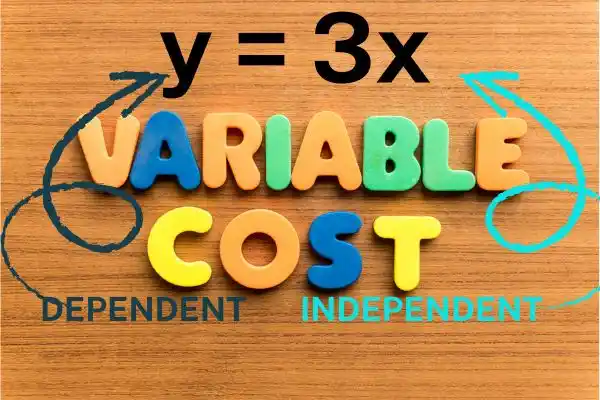
Calculation table:
| f (kg) | h (cm) |
| 1 | 7 |
| 2 | 10 |
| 4 | 16 |
The height (h) changes based on the fertilizer (f), so here h is dependent, and f is independent.
Controlled variables
controlled variables are constants kept fixed in an equation or experiment to ensure accuracy.
example:
[
h = 3f + 4
]
- constants like sunlight, pot size, or soil type are controlled
- The independent variable (f) changes and height (h) is calculated
calculation:
- (f = 3), (h = 3(3) + 4 = 13) cm
- (f = 6), (h = 3(6) + 4 = 22) cm
Here (+4) is part of the controlled value in the formula.
Integer variables
Integer variables can only take whole-number values. They are used in counting or discrete quantities.
example: number of students (n)
[
t = 2n + 5
]
- (t) = total pencils distributed
Calculation:
- (n = 4), (t = 2(4) + 5 = 13)
- (n = 7), (t = 2(7) + 5 = 19)
Fractional values are not valid for integer variables.
Types and categories of dependent and independent variables
Variables can be understood by separating role from value type.
Independent and Dependent variables describe the role a variable plays in an equation. The Independent is the input, and the Dependent is the result calculated from it.
Discrete, Continuous, Integer, and Categorical describe the kind of values a variable can take. These types are not restricted to one role. Any of them can be independent and dependent variables, depending on how the equation is written. For example, a counting variable is Discrete whether it is used as an input or appears as an output. The same applies to Continuous and Integer variables.
Controlled Variables do not belong to either the Independent or Dependent category. They are kept fixed so they do not influence the relationship being studied. In algebra, controlled variables usually appear as constants or fixed numbers in an expression.
In simple terms, Independent and Dependent explain how a variable is used, while Discrete, Continuous, Integer, and Categorical explain what kind of values it can have. Controlled Variables stand apart because they do not change and are not solved for.
: Dependent and independent Variables can be classified based on their role and the type of values they take.
1. independent variable
- Definition: input or manipulated variable
- algebraic example: (y = 2x + 3)
- calculation: (x = 4), (y = 2(4) + 3 = 11)
2. Dependent variable
- Definition: output variable calculated from the independent variable
- algebraic example: (y = 2x + 3)
- calculation: (x = 7), (y = 2(7) + 3 = 17)
3. Controlled variable
- Definition: a constant or fixed value in a formula
- algebraic example: (+3) in (y = 2x + 3)
- calculation: keeps the equation stable while changing (x)
4. Discrete variable
- Definition: a variable that takes specific, separate values
- example: (n) = number of cars
- equation: total wheels = (w = 4n)
- calculation: (n = 3), (w = 12); (n = 5), (w = 20)
5. Continuous variable
- Definition: a variable that can take any value in a range
- example: temperature (t)
- equation: plant growth (g = 1.5t + 2)
- calculation: (t = 10.2), (g = 17.3); (t = 15.5), (g = 25.25)
6. Categorical variable
- definition: represents categories rather than numbers
- example: grades (a, b, c, d)
- calculation: count students in each category: a = 5, b = 7, c = 3 → total = 15
full algebra example
Scenario: Calculate total marks based on study hours (h) and practice hours (p)
formula:
[
m = 5h + 3p + 50
]
- independent variables: (h), (p)
- dependent variable: (m)
- controlled variables: exam type, classroom conditions
Calculation table:
| h (hours) | p (hours) | m = 5h + 3p + 50 | m (marks) |
| 2 | 1 | 5(2) + 3(1) + 50 | 63 |
| 4 | 2 | 5(4) + 3(2) + 50 | 76 |
| 6 | 3 | 5(6) + 3(3) + 50 | 89 |
This shows how independent variables are used in algebraic equations to calculate dependent variables while keeping controlled variables constant.
Conclusion
Independent and dependent Variables are essential in algebra to express relationships, perform calculations, and solve problems. Understanding the meaning and types of variables helps in writing equations and finding results:
- independent variables: manipulated inputs
- dependent variables: calculated outputs
- controlled variables: constants kept fixed
- integer variables: whole numbers for counting
- types: discrete, continuous, and categorical
Algebraic equations like (y = 2x + 3) or (m = 5h + 3p + 50) allow precise calculations and predictions, making independent and dependent variables a central concept in algebra.